An Open Educational Resource

A History of
Educational Thought

An interactive timeline tracing two and a half millennia of ideas about how human beings learn, teach, and come to know — from Confucius to Christodoulou.

57 Thinkers
2,500 Years of thought
40 Connections
16 Historical markers
Scroll to explore

The Resource

Timeline header and theme filters

The header and interactive theme filters — allowing users to isolate traditions of thought across the full timeline.

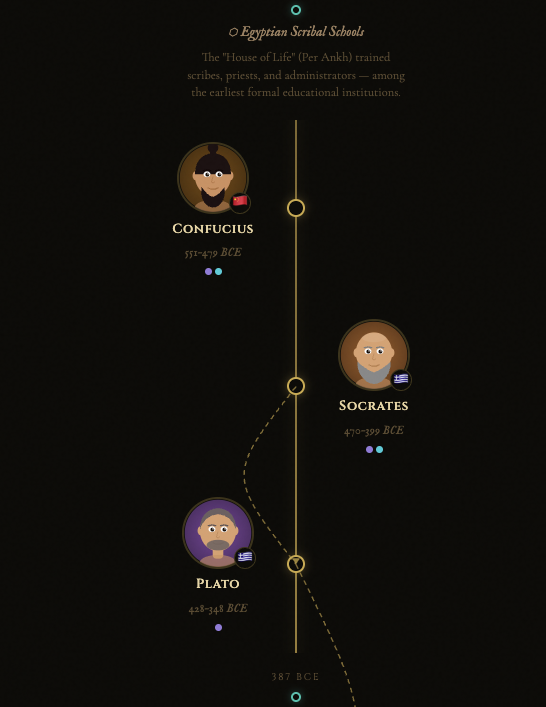
A section of the timeline

The vertical timeline spine, with thinkers alternating left and right, contextual markers, and era labels.

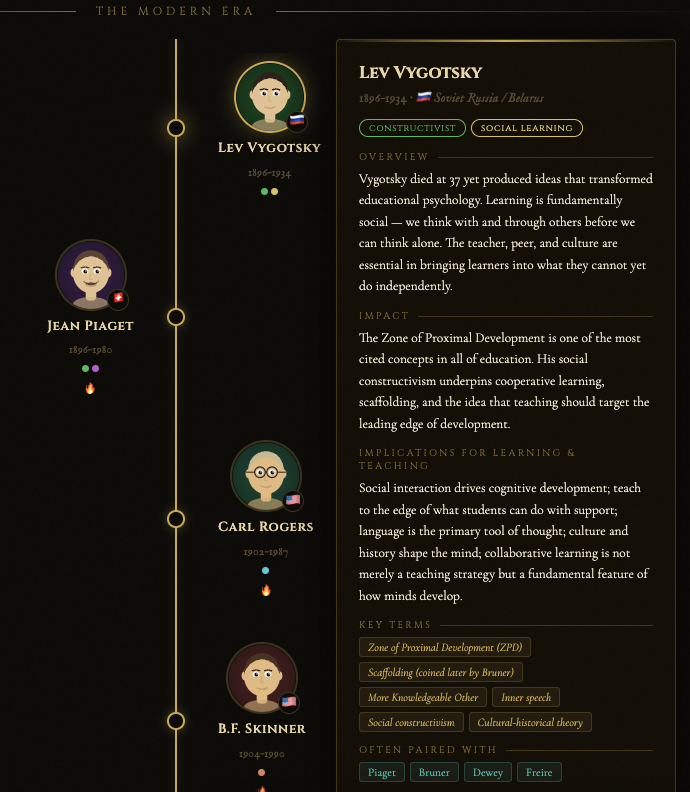
An open thinker detail card

Clicking a portrait reveals a structured summary: overview, impact, teaching implications, key terms, and related thinkers.

About
This Resource

A History of Educational Thought is an interactive reference timeline designed for students of education, trainee teachers, and anyone who wants to understand where contemporary ideas about learning and teaching actually come from. It maps 57 significant thinkers from ancient philosophy through to contemporary cognitive science — not as a list of names and dates, but as a living web of ideas, influences, and ongoing debates.

Each figure is presented with a structured summary of their core ideas, their impact on educational theory and practice, and their direct implications for learning and teaching. Key terms are surfaced explicitly — so that concepts like Zone of Proximal Development, cognitive load, cultural hegemony, or advance organisers are always connected to the thinker who developed them and the tradition they belong to.

The resource is intentionally global and pluralist. Alongside the canonical Western tradition — Socrates, Locke, Dewey, Piaget — it includes Ibn Sina, Ibn Khaldun, Confucius, Rabindranath Tagore, Julius Nyerere, B.R. Ambedkar, Anna Julia Cooper, and bell hooks. Educational thought has never been the property of one tradition, and the timeline refuses to pretend otherwise.

Theme Filters Eight intellectual traditions — from Constructivist to Behaviourist to Critical Pedagogy — can be toggled to collapse the timeline around any school of thought.
Connection Lines Toggle visible lines of influence, teaching relationships, and critical disputes — showing who shaped whom and where the arguments lie.
Historical Markers Sixteen contextual anchors — the printing press, compulsory schooling, the cognitive revolution, the World Wide Web — place educational thought inside broader history.
🔥
Live Debates Thinkers whose ideas remain actively contested in schools and research today are flagged — reminding students that this is not settled history but ongoing argument.

Why This Matters

Educational ideas do not appear from nowhere. Every practice in every classroom descends from a philosophy. Knowing the genealogy of those ideas is not an academic luxury — it is the foundation of becoming a thoughtful, critical practitioner.

I

Tracing Educational
Thought Across Millennia

When a teacher uses Socratic questioning, they are drawing on a method developed in Athens in the fifth century BCE. When they scaffold a task, they are applying a concept rooted in Vygotsky's social constructivism, developed in revolutionary Russia in the 1930s. When they sequence retrieval practice, they are operationalising research produced in cognitive psychology laboratories in the 1980s and 90s.

The timeline makes these lineages visible — connecting the moment of practice back through the chain of thought that produced it. For education students, this transforms abstract theory into meaningful context: ideas have origins, histories, and rivals, and understanding them as such produces far richer professional thinking than treating them as isolated frameworks to be applied.

II

Seeing the Connections and Genealogy of Thought

No significant educational thinker worked in isolation. Rousseau read Locke and argued with him. Pestalozzi read Rousseau and took his ideas into practice. Froebel studied under Pestalozzi. Montessori built on Froebel. Dewey cited Pestalozzi explicitly. Bruner synthesised Piaget and Vygotsky. Hirsch answered Dewey. Christodoulou answered Hirsch's critics.

The connection lines in this timeline make that genealogy navigable. Students can trace lineages of influence — seeing, for instance, how the Romantic child-centred tradition runs from Rousseau through Froebel to Montessori to contemporary play-based learning — and begin to understand why certain debates recur, why certain arguments keep finding new advocates, and why some ideas prove more durable than others.

III

Understanding the Debates and Overlaps in Educational Thinking

The most important debates in education — knowledge versus skills, direct instruction versus inquiry-based learning, the purpose of the curriculum, the role of the teacher — are not new arguments. They are the same arguments, recurring in new forms across centuries. Quintilian and Skinner are both concerned with effective instruction. Freire and Hirsch are both concerned with educational justice. They reach opposite conclusions.

The theme filters allow students to isolate and compare these traditions directly — placing behaviourists and constructivists side by side, or tracking the critical pedagogy tradition from Gramsci through Freire to hooks. Understanding where thinkers agree, where they diverge, and why those divergences matter in practice is what separates a reflective practitioner from one who simply applies received wisdom.

The history of educational thought is not a museum of dead ideas. It is the living argument about what human beings owe each other — and what it means to help someone learn.
A History of Educational Thought